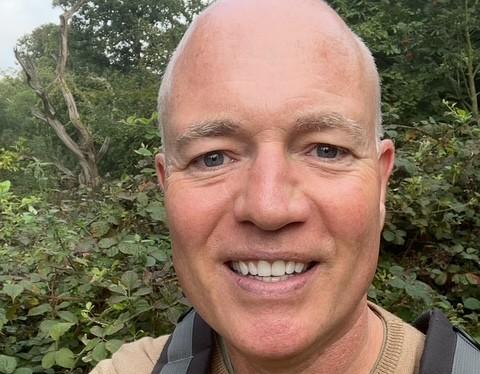
I was diagnosed in the summer of 2025 when I was 57, but looking back on it, I think I probably had symptoms for a year, possibly more.
Pre-diagnosis
I have always enjoyed exercise and going to the gym. In fact, it was at the gym where I first noticed something wasn’t right in my body. It was on the recumbent bike. I noticed some pinching in the top of my thigh whilst I was cycling. I didn’t think much of it at first and assumed I had probably just pulled a muscle. However, I did noticed that if I used the upright bike, I was fine and didn’t have any discomfort at all.
After a few weeks, I introduced the rowing machine into my cardio workout, and I noticed almost right away that the pinching sensation in my upper thigh came back. Again, I put it down to a pulled muscle or maybe just a groin strain and thought time would resolve it. In my mind, I also considered that it could possibly be an inguinal hernia because the discomfort was in that area, but I didn’t do anything right away.
Looking back on it, I think I could have – and probably should have – gone to the GP at that stage. But, as I didn’t have constant pain or any other symptoms, I assumed that it would get better with a bit of time. I certainly didn’t think it was ‘serious’ enough to go to the GP. In hindsight, I think that pinching discomfort was due to a swollen lymph node that was catching a nerve or neighbouring tissue whilst I was exercising.
Getting a diagnosis
After a while things still hadn’t resolved. I went to the GP and was referred for an ultrasound. When I had the ultrasound, I half expected them to tell me I had a hernia. But they said it looked like I had a swollen lymph node, so a biopsy and then a PET/CT scan were organised. After this, I was given an appointment with the hospital’s haematology team where I was diagnosed with nodular lymphocyte predominant Hodgkin lymphoma (NLPHL), stage 3. After explaining the findings and staging, I was then told that I wouldn’t need treatment straightaway but instead would be put on active monitoring (or watch and wait) until such time as treatment was needed.
A cancer diagnosis is always hard. Your life changes in an instant. There is a lot to take in and process. I recall that first meeting very well. I was given a lot of information, but after a while, I knew I wasn’t taking it all in. Getting the diagnosis was important, and having the treatment plan explained was key to that meeting, but I knew for me to come to terms with this diagnosis, I needed more information and would need to spend more time to really research it and understand the disease. I did that and I am glad that I did because this knowledge and understanding helped me reach a place of acceptance of my diagnosis.
Post-diagnosis
Initially, I found being on active monitoring a challenge. It was a challenge because it kind of goes against the grain of what we normally do in life. For example, if something is found to be wrong with your car, you make an appointment with the mechanic and get it fixed. You don’t wait, you get it sorted out as soon as you can. So I assumed, if something was wrong with my body, the haematology team at the hospital would be like the mechanics with my car – they’d get right on and sort it out! But this wasn’t going to be my immediate treatment plan. I was told that I had got cancer but wouldn’t have treatment until it was needed.
I think I had two main concerns about this active monitoring treatment plan. The first was I thought it went against all the messaging I had received over years from cancer campaigns in the media and everything I’d ever really heard about cancer. The messaging that I had always got – and had definitely stuck in my mind – was that the earlier the diagnosis – and by implication, treatment – the better the outcome. So I assumed, stage 3, I’d be fast tracked to chemo right away. But that wasn’t happening. Instead, I was being told that my condition would be closely monitored and we would only start treatment if and when it was needed.
This leads on to my second concern which was that it is going to be my call: I will have to contact the haematology team when more serious lymphoma symptoms start to manifest. I think my worry was that since I hadn’t picked up on the signals my body was giving me as this cancer was developing in my body, and because I didn’t go to the GP until I was stage 3, a subjective, self-referral was a bit daunting, because I didn’t want to miss the signals a second time. I imagined the implications of starting treatment late might be more serious this time.
For me to resolve and settle these concerns, once again, I knew that I was going to have to understand the rationale of what we were doing to really be OK with it. Of course, I trusted the experts but I wanted to know more to be completely OK and feel we were in control of it. In reading about my cancer, I began to understand that there are lots of different types of lymphoma and each type is treated differently. Once I understood this, I was really fine with the active monitoring treatment plan. I have regular blood tests and appointments throughout the year with the haematology team and if I am ever worried or concerned about anything, I have a direct phone line contact for support and advice in the hospital.
With time, I have come to learn that cancer progression, especially NLPHL does not grow and develop in a straight line in terms of when things get worse. NLPHL can stop or slow its progression for some time. And there are no advantages to initiating treatment before it is really necessary. The rationale for waiting and monitoring the disease now makes sense. I understand that I might face chemotherapy treatment down the road but I am not afraid of it. I am living each day positively and am taking good care of myself. I am confident that should I need treatment in the future, I will be in good shape physically and mentally to have it.
Moving forward
Whilst I can’t control what the cancer is doing in my body, I know that there are some things I can do to optimise my health for the future and what it holds for me. I can control things like exercise, work, sleep, food and mental health. To support my physical condition, I eat well and exercise regularly. I pace myself now. I don’t overdo it and I rest when I need to. I do take some supplements (D3 and Zinc) to aid my immune system.
To support my mental health, I have a monthly support group meeting with Lymphoma Action. I have connected with others who are going through a similar situation as me. We are all learning and supporting each other. I have a buddy who talked me through his experience of active monitoring and treatment. His first hand experience and encouragement was very helpful to me understanding my disease. In addition, I have also engaged a private counsellor who I see once a month to talk through any concerns I may have. And of course, I have my close friends.
I live alone and don’t have any immediate family so my friendship support is very important to me. They have been great. I took the decision to only tell a core group of friends about my diagnosis because whilst I am on active monitoring my life is carrying on much as it was before, and I didn’t really want to – on the other hand, cause people unnecessarily worry before they need to think about it – and on the other, I didn’t want to deal with other people’s reactions and emotions to my diagnosis.
One other thing I have had to contemplate and organise is the end of life stuff. Whilst this is a bit uncomfortable, I think it’s important and something that we will all have to address because none of us is infallible and will die one day. After my diagnosis, I sorted out a Power of Attorney for health and financial matters, and also wrote my Will. There was definitely a sense of peace in having this done and filed away for one day.
Right now, going forward, I am guided by some words that were shared with me during my consultation at the hospital. This has been a bit of a mantra for me and I am happy to share it with others who find themselves in a similar situation to me: Live each day according to how you feel, and not by the label of your diagnosis. I wish you all well.